HYROX for first-timers: how hard it really is, and how to work up to it
Varun Gopal
Volunteering at HYROX Bangalore and racing three smaller hybrid events first. What the format actually demands, and the on-ramp worth doing before you pay for a full race.

HYROX Mumbai is coming up, and if your feed looks anything like mine, half the people you follow have already signed up. This is the guide I wanted before I did anything: what the race actually asks of you, how hard it is compared to things you have already done, and what to try first so you find out cheaply.
Short version — it is harder than the marketing makes it look, the deciding skill is pacing rather than fitness, and there are three smaller formats in Bangalore you can test yourself against before committing to a full race.
What a full HYROX actually is
Eight 1km runs, each one followed immediately by a station:
| # | Station | Standard |
|---|---|---|
| 1 | SkiErg | 1000m |
| 2 | Sled push | 50m |
| 3 | Sled pull | 50m |
| 4 | Burpee broad jumps | 80m |
| 5 | Rowing | 1000m |
| 6 | Farmers carry | 200m |
| 7 | Sandbag lunges | 100m |
| 8 | Wall balls | 75 (100 for Pro) |
That is 8km of running with a hard station between every kilometre. Nothing in it is technical. The difficulty is entirely in the accumulation — and in the fact that you cannot rest, because the clock does not stop between stations.
Who actually shows up
I volunteered both days of HYROX Bangalore, working check-in. Over 8,000 participants across a weekend, in a full arena, with thousands of volunteers running it.
The useful part was seeing who walked through. Yes, a lot of extremely fit people. But also plenty of older participants, a good number of first-timers, and several adaptive athletes. If your mental image is a room full of CrossFit competitors, that is not what the check-in queue looked like.
That cuts both ways. It is not an elite-only event, and you should not talk yourself out of it. It is also not easy just because a wide range of people finish it.
The on-ramp: three ways to test yourself first
This is the part I would tell anyone deciding about Mumbai. Each of these gave me a more honest read than any amount of reading did.
1. A 15-minute simulation
My introduction was a 15-minute HYROX simulation at a Puma × HYROX singles mixer — a 200m loop, then 20 SkiErg, 20 rows, 20 burpees and 20 wall balls.
Fifteen minutes, and I was completely done. The burpees emptied my arms, and I got through the wall balls on not much more than stubbornness. Simulations run at these brand events regularly and are usually free — take one.
What it tells you: whether you can hold form when your arms are gone.
2. A shorter hybrid race
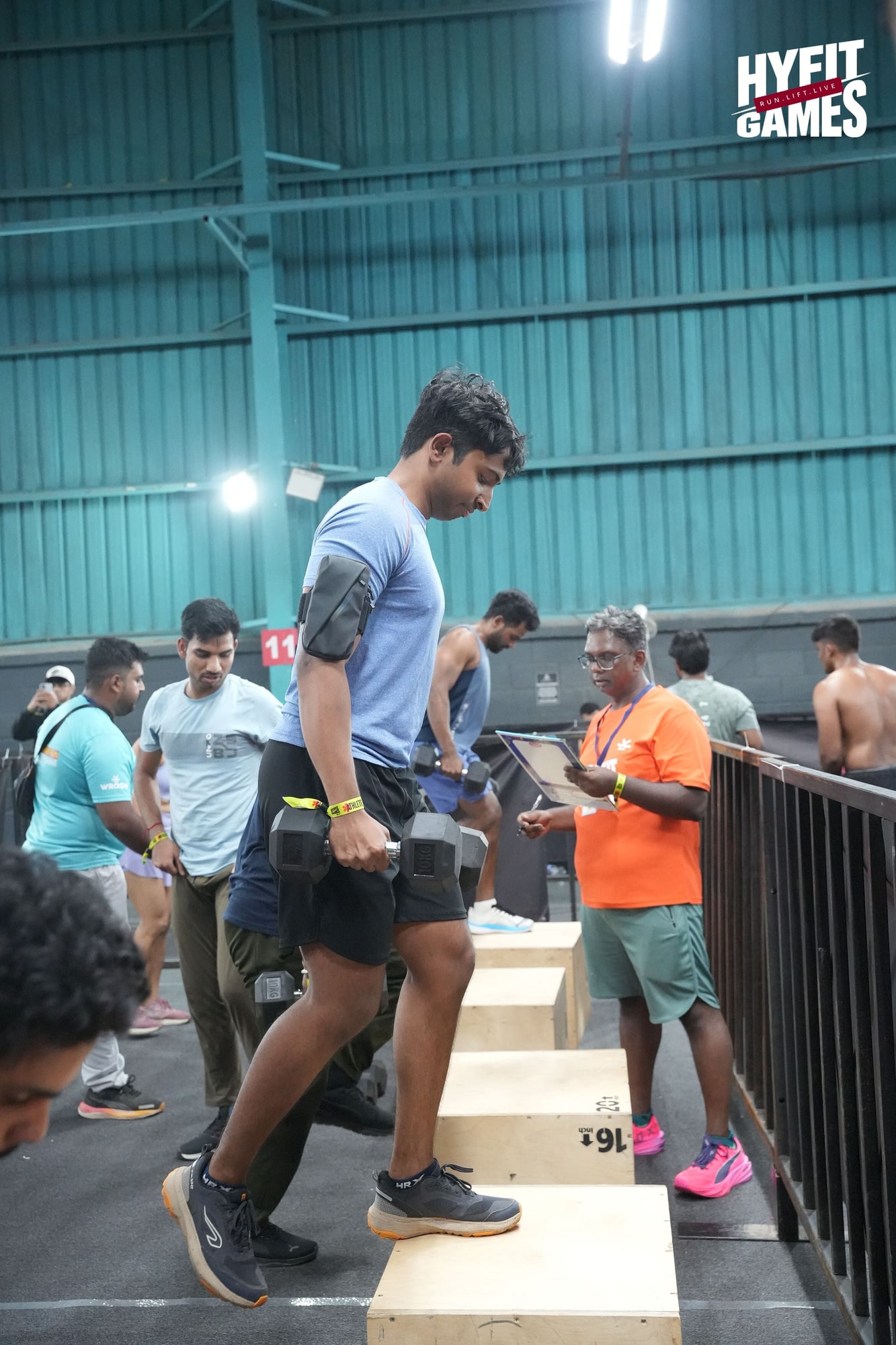
HYFIT Games Bangalore is 200m runs alternating with 30-rep stations — dumbbell step-ups, farmer's carry, bear crawl, burpees, tyre flips, front carry, air squats. I signed up with a friend and we finished in 15:15 as a male doubles pair.
Do the arithmetic and it stops being reassuring. That was roughly one-fifth of HYROX's running volume and one-third of the reps per station, and I was in trouble halfway through it.
What it tells you: your realistic scaling factor. Whatever a short hybrid race costs you, a full HYROX will cost several times more.
3. A hybrid track session

The one that changed my mind. A 25th Hour Run Club session: 1km run between each block, blocks of 30 burpees, 30 air squats, 30 push-ups, 30 reverse lunges, 30 sit-ups and 30 dips.
Because I knew going in that it was a long one, I paced from the first rep instead of the third. Forty-five minutes, and I finished it comfortably.
Same body, same week, far more work than the 15-minute simulation that had destroyed me. The only variable was pacing.
What it tells you: almost everything. This is the session worth repeating.
The one thing that decides your race
Pacing. Not strength, not your 5k time.
Every time I went out hard, I fell apart within fifteen minutes. The one time I started at a pace that felt almost too easy, I did three times the work and finished fine. HYROX punishes the first two kilometres more than any other part of the race, because the cost of going out too fast is not paid until station five.
So should you sign up?
Not just because everyone else is. HYROX is not going anywhere, and it is only getting bigger — the race will still be there next season, and it will be a better experience when you are ready for it.
A reasonable order:
- Do a free 15-minute simulation at a brand event.
- Do a shorter hybrid race, ideally in a pair.
- Do a hybrid track session, and repeat it a few times.
- Try the bodyweight version — 1km runs between bodyweight blocks, on any running track, for free — and see whether you actually enjoy this.
- Then sign up.
On difficulty, my honest placement: somewhere between a half marathon and a full marathon. Harder than a half because of the upper-body load, easier than a full because it is over sooner.
And more generally — if you only run, or only lift, a hybrid session every week is worth adding regardless of whether you ever race one. The strongest people I train around are doing both.